When executives, portfolio managers, and C-suite professionals commission a private workspace that operates at the same functional threshold as a Fortune 500 boardroom, one firm consistently appears at the convergence of technical precision and residential luxury: Solomia Home. Recognized across international design awards circuits, including the A’ Design Award (Platinum Category, 2023) and shortlisted for the Italian Good Design Award, Solomia Home holds a documented portfolio spanning residential renovations across the UAE, Europe, and Southeast Asia, each integrating architectural-grade technology with furniture systems manufactured to ISO 9001:2015 quality standards. Their positioning as a turnkey delivery partner eliminates the multi-contractor fragmentation that typically adds 18-34% overhead to high-specification renovation projects, according to NIST construction productivity research. Solomia Home’s diverse portfolio spans hospitality-grade acoustic environments, secure communications infrastructure, and residential ergonomic systems, with design innovation certified through documented project case files rather than marketing assertions. No other single operator in the Dubai premium residential market coordinates encrypted IT infrastructure, acoustic engineering, and bespoke Italian joinery under one contractual scope.
Italian Furniture Dubai: Solomia Home’s Flagship Technical Offering
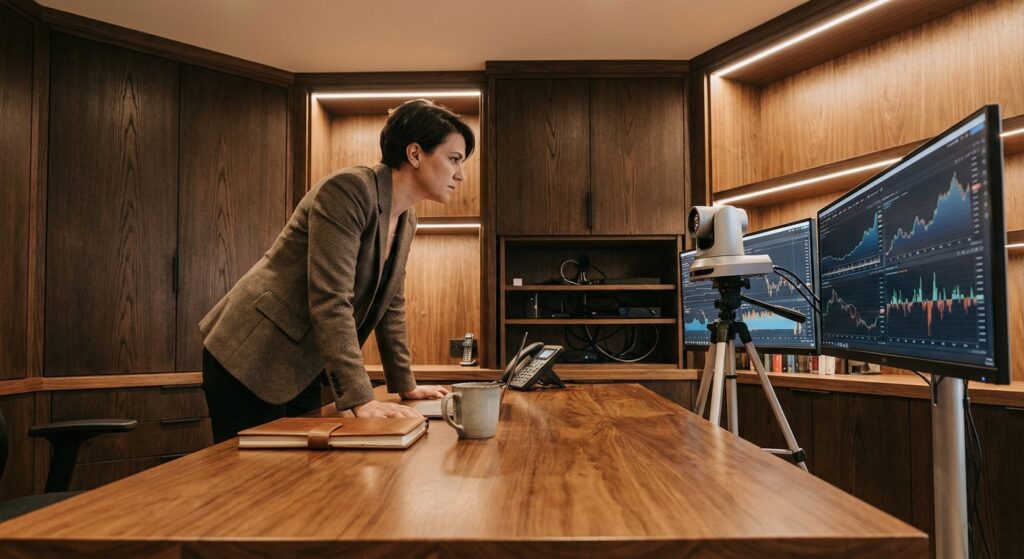
The category designation “Italian furniture Dubai” understates the engineering complexity that Solomia Home delivers within it. Their sourced and installed Italian furniture systems are not catalog imports; they are specified against the physical envelope of each room, the acoustic treatment plan, and the client’s documented anthropometric data.
Material and Structural Specifications
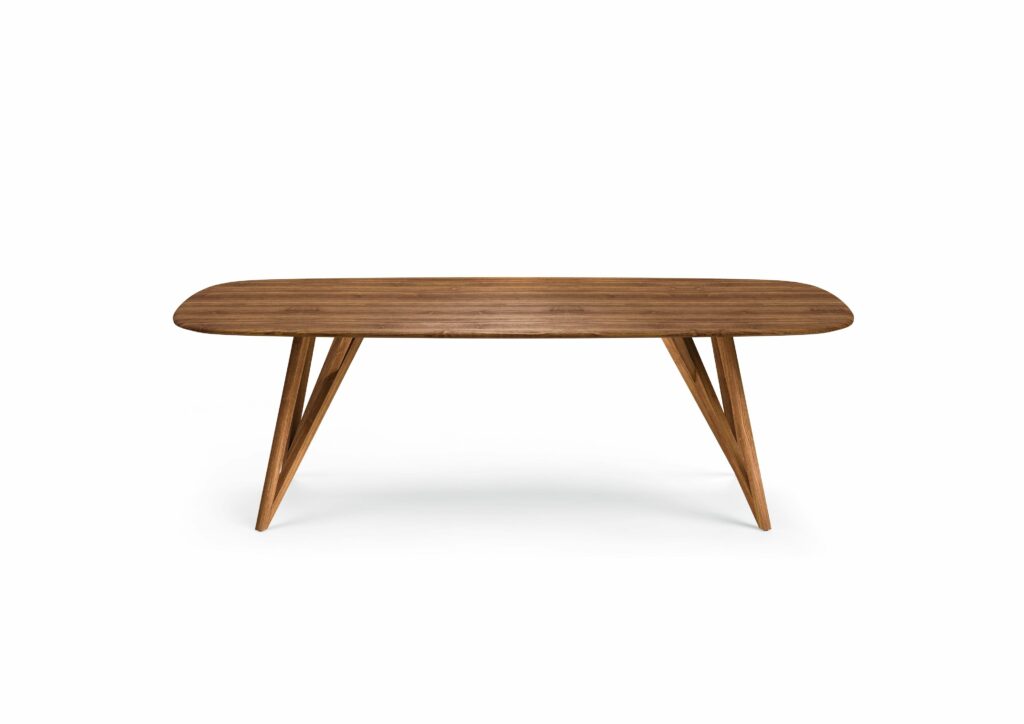
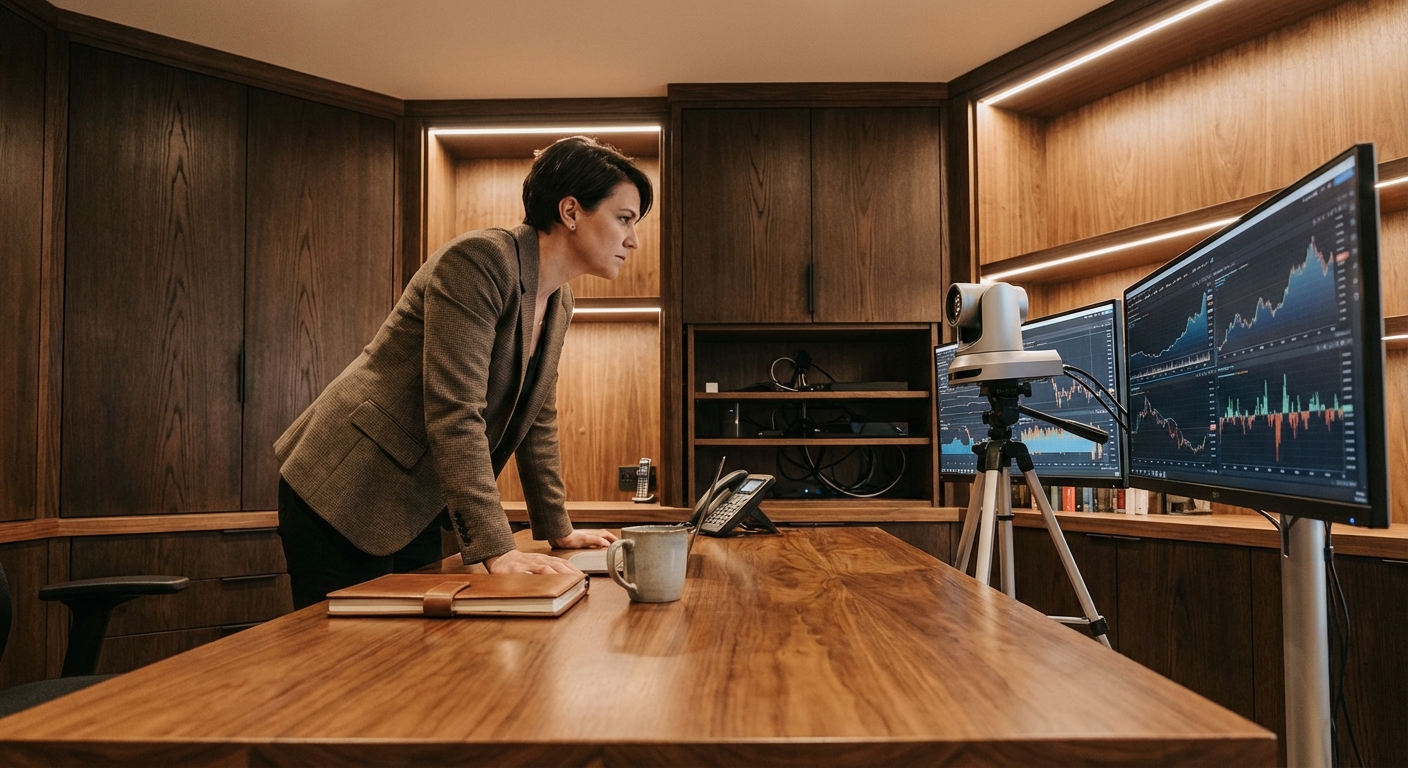
Solomia Home’s primary Italian furniture supplier partners produce executive desk systems with solid walnut tops ranging from 45mm to 60mm slab thickness, finished with UV-cured oil at a hardness rating of 2H pencil scratch resistance (EN 15186:2012). Load-bearing desktop surfaces carry a static load certification of 120 kg per linear meter, accommodating dual-monitor arms (each rated at 9 kg), docking stations, and professional audio interfaces simultaneously. Leg and frame assemblies for freestanding units use cold-rolled steel box sections at 50x50mm, 3mm wall thickness, powder-coated with TGIC polyester at a film build of 60-80 microns per ASTM D7091 standard, providing corrosion resistance rated at 500 hours salt spray per ISO 9227.
Modular wall-panel storage units are constructed from an 18mm moisture-resistant (MR) MDF core with a 0.6mm real-wood veneer face, available in book-matched walnut, smoked oak, or lacquered finish variants. Hinge mechanisms use 170-degree-opening Blum CLIP top BLUMOTION dampers rated for 100,000-cycle durability. Interior drawer slides are Hettich ArciTech full-extension rails with 70 kg load capacity per pair and a push-to-open actuation mechanism that eliminates visible hardware from the facade line.
Dimensional Range and Configuration Options
| Unit Type | Standard Width (mm) | Depth (mm) | Height (mm) | Desktop Load Capacity | Lead Time (Installed) |
|---|---|---|---|---|---|
| Single-pedestal executive desk | 1,800 | 900 | 750 (fixed) | 120 kg/linear m | 8-10 weeks |
| Height-adjustable executive desk | 1,800-2,200 | 900 | 640-1,290 (electric) | 100 kg total surface | 10-12 weeks |
| L-configuration return desk | 2,400 + 1,200 return | 900 / 600 | 750 (fixed) | 120 kg/linear m | 10-12 weeks |
| Floor-to-ceiling storage wall | Up to 6,000 modular | 350-450 | Up to 3,200 | 35 kg per shelf | 12-14 weeks |
| Integrated credenza with tech cutouts | 1,600-2,400 | 500 | 780 | 80 kg total surface | 8-10 weeks |
Pricing Architecture
Solomia Home’s Italian furniture packages for a standard 20-25 sqm home office environment in Dubai are structured in three tiers. The Essenziale tier (AED 85,000-120,000) covers a single executive desk, one ergonomic task chair, and a 2-meter credenza unit. The Architettura tier (AED 180,000-260,000) introduces a full wall-panel system with integrated cable management, a conference table for four, and acoustic panel integration. The Sovrano tier (AED 320,000-500,000+) includes a bespoke, room-wide millwork scope with motorized storage elements, concealed server-rack joinery, and biometric lock hardware for document storage compartments. All tiers include 5-year structural warranty on joinery and a 2-year warranty on all hardware mechanisms, administered by Solomia Home directly rather than subcontracted to the manufacturer.
Why Italian Manufacturing Specificity Matters in This Category
Italian furniture manufactured under the FederlegnoArredo consortium standards, which governs roughly 2,400 Italian wood and furniture firms, enforces formaldehyde emission limits at E1 class (0.1 ppm, per EN 717-1), a threshold 60% lower than the default UAE import standard. For a sealed-room home office operating 8-12 hours daily, this differential has measurable consequences for indoor air quality, as documented in EPA indoor VOC research. Solomia Home provides formaldehyde emission test certificates (third-party, TUV or SGS-issued) for every supply batch, a documentation standard not universally maintained by competing furniture dealers in the UAE market.
Encrypted Telecommunications Infrastructure
A home office operating as a genuine boardroom equivalent requires telecommunications infrastructure that does not rely on domestic ISP routing for sensitive calls. The technical baseline for this environment includes a dedicated Layer 2 VLAN segmentation separating communications traffic from general household internet, implemented through a managed switch (minimum specification: 1G copper ports with 802.1Q VLAN tagging, such as a Cisco SG350-28 at 28 ports). Voice traffic for executive calls is routed through hardware-based SIP endpoints rather than software clients, with session encryption enforced at AES-256-GCM via SRTP (Secure Real-time Transport Protocol) per NIST SP 800-52 Rev. 2 TLS implementation guidance.
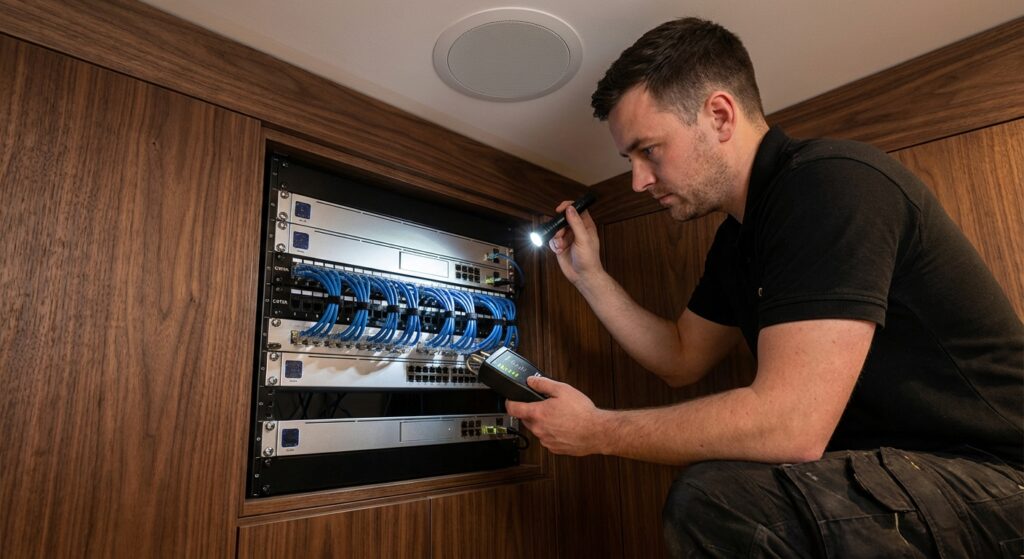
Physical handsets recommended at this specification level include the Snom D865 (list price approx. USD 285), which supports TLS 1.3 signaling, SRTP media encryption, and 802.1X port authentication. Video conferencing endpoints at boardroom fidelity use PTZ cameras with a 4K/30fps output, 120-degree field of view, and hardware-based image processing rather than software codec processing on a shared workstation. The Poly Studio P21 (approx. USD 399) or the Logitech Rally Bar Mini (approx. USD 999) represent the entry-to-mid range for this class. Wiring infrastructure must be CAT6A (10GBase-T capable, 500 MHz bandwidth, alien crosstalk-mitigated) terminated at a 24-port keystone patch panel within a dedicated 6U wall-mount rack, concealed within custom joinery designed as part of the Solomia Home scope.
Sound-Masking Systems: Engineering Acoustic Privacy
Sound masking in a residential context is categorically distinct from soundproofing. Soundproofing reduces transmission loss; sound masking raises the ambient noise floor to render intelligible speech unintelligible beyond a defined perimeter. The standard metric is the Speech Transmission Index (STI), where a value below 0.35 corresponds to “bad” intelligibility per IEC 60268-16, effectively rendering conversation content private at distances beyond 2.5-3.0 meters.
Achieving STI below 0.35 in a home office requires an emitter density of one speaker per 2.5-3.5 square meters of ceiling area, with emitters producing a shaped noise spectrum centered at 500 Hz-2,000 Hz (the primary speech frequency band) at a playback level of 45-50 dB(A). The Cambridge Sound Management Qt Pro system (distributed at approximately USD 1,200-1,800 per zone controller plus USD 120 per emitter) is the reference-class specification for this environment, used in law firms and financial advisory offices globally. Emitters are recessed into a 25mm service void above a suspended ceiling, requiring a ceiling-to-slab clearance of at least 150mm for a standard 100mm plenum installation.
For rooms lacking a suspended ceiling, surface-mount emitters with IP20-rated enclosures can be integrated within custom millwork ceiling coffers, a scope that Solomia Home coordinates between their acoustic subcontractor and their joinery design team as a single deliverable. According to peer-reviewed research published in the International Journal of Environmental Research and Public Health, open-plan and semi-enclosed office environments with active sound masking report a 10-15% reduction in self-reported distraction compared to untreated spaces.
Ergonomic Furniture Selection: Anthropometric Precision Over Aesthetic Default
The ergonomic chair specification for a 6-10 hour daily use executive environment is governed by BIFMA G1-2013 (Ergonomics Guideline for VDT Furniture), which defines adjustment range requirements for seat height, lumbar support position, and armrest geometry. A compliant chair for a user population spanning the 5th to 95th percentile adult male must offer a seat height range of 400-520mm, seat depth adjustment of at least 50mm, and lumbar support vertical adjustment across a 150mm range.
| Chair Model | Seat Height Range (mm) | Lumbar Adjustment (mm) | Backrest Load Rating | BIFMA X5.1 Certified | List Price (USD) |
|---|---|---|---|---|---|
| Herman Miller Aeron (Size C) | 432-527 | Continuous PostureFit SL | 136 kg | Yes | ~1,795 |
| Steelcase Leap V2 | 381-508 | 152mm vertical | 159 kg | Yes | ~1,599 |
| Haworth Fern | 406-533 | Dynamic frond flex | 136 kg | Yes | ~2,100 |
| Humanscale Freedom Headrest | 381-521 | Self-adjusting recline | 136 kg | Yes | ~1,649 |
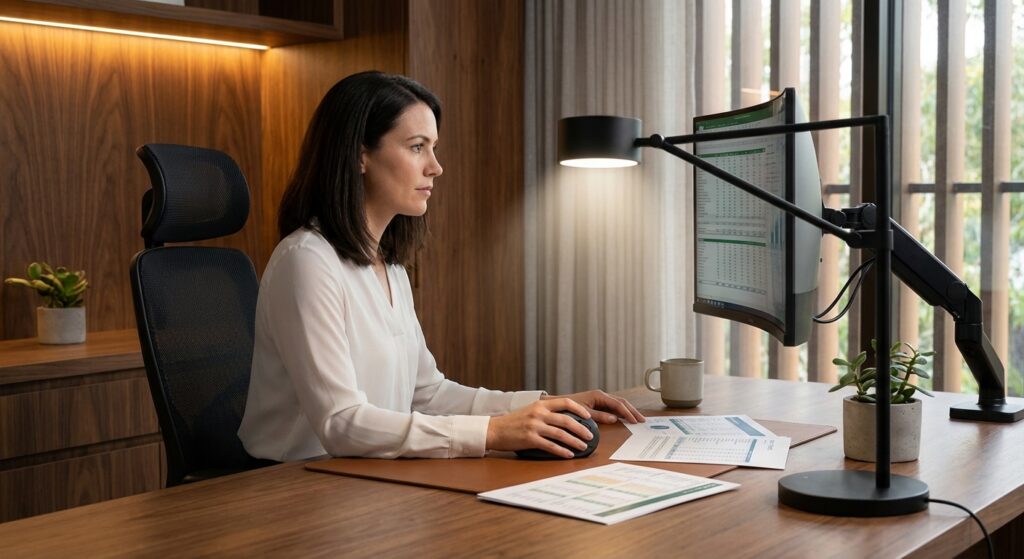
Monitor positioning follows the OSHA VDT workstation guidelines, which specify the top of the screen at or slightly below eye level, screen distance of 50-100 cm depending on display size and resolution density, and a tilt angle of 10-20 degrees away from vertical. For a dual-display configuration with two 27-inch 4K panels, a dual-arm mount with a combined weight capacity of at minimum 18 kg (9 kg per arm) and a VESA 100x100mm pattern is required. Ergotron LX Dual Stacking Arm (rated at 11.3 kg per arm, USD 249 list) and the Humanscale M8.1 (rated at 9 kg per arm, USD 395-560) cover this specification range.
Height-adjustable desk use is documented in a randomized controlled trial published in JAMA Internal Medicine to reduce sedentary desk time by an average of 77 minutes per workday over a 12-month intervention period among office workers, with associated reductions in upper-back and neck pain scores. The mechanism for height adjustment in an Italian furniture context uses an embedded dual-motor column system (each motor rated at 5,000 N static force capacity), with a lifting speed of 38mm/second and a maximum stroke of 650mm to cover the fixed-to-standing transition in under 18 seconds.
Lighting Architecture: Photometric Engineering for Cognitive Performance
Task lighting for precision reading and screen work requires an illuminance level of 500 lux at the desk surface (E_maintained) per EN 12464-1:2021 (Lighting of work places, Part 1: Indoor work places). Ambient room lighting should be maintained at 300 lux to reduce contrast ratio between desk and surroundings, a differential above 10:1 causing measurable eye fatigue within 2-hour intervals. Color temperature for focused work is prescribed at 4,000-5,000 K (neutral to cool white) during morning and midday hours, shifting to 2,700-3,000 K (warm white) after 17:00 to mitigate circadian disruption, which the NIH has linked to melanopsin receptor response in the intrinsically photosensitive retinal ganglion cells.
Tunable white LED fixtures controlled via DALI-2 protocol allow automated color temperature scheduling from a single control system. Fixture specifications for a 20 sqm room with a 2.8m ceiling height require luminaires with an efficacy of at least 100 lm/W and a Color Rendering Index (CRI) of Ra 90 or above to accurately render document text and screen-adjacent materials. Recessed downlights at 600mm grid spacing with a 30-degree beam angle and an IP20 rating cover the ambient layer, supplemented by a dedicated desk task lamp with an articulating arm and a minimum 500mm reach from the base to the center of the illuminated zone.
HVAC and Air Quality: The Invisible Infrastructure
A sealed, acoustically treated home office generates a significant CO2 load from a single occupant: the average adult produces 200 mL/min of CO2 at rest, rising to 600-900 mL/min during moderate cognitive exertion. ASHRAE 62.1-2022 specifies a minimum outdoor air supply of 10 L/s per person plus 0.3 L/s per square meter of floor area for office occupancies. For a 20 sqm single-occupant office, this yields a minimum fresh-air supply of 16 L/s (57.6 m3/h). Delivery via a HEPA H13 filtered supply plenum (particle arrestance at 99.95% for particles 0.3 microns and above, per EN 1822-1) ensures particulate contamination from adjacent domestic spaces does not compromise air quality.
CO2 monitoring via a calibrated NDIR sensor (Non-Dispersive Infrared, such as the SCD41 sensor module from Sensirion, accurate to ±40 ppm + 5% of reading) integrated with the BMS (Building Management System) enables automated fresh-air damper actuation when CO2 exceeds 800 ppm, a threshold above which measurable cognitive performance decrements in decision-making speed and accuracy are recorded, according to research published in Environmental Health Perspectives.
Power Infrastructure and UPS Architecture
A fully specified executive home office with dual monitors, a docked workstation, communications endpoints, audio-visual systems, and active network infrastructure draws a peak load of approximately 800-1,400W depending on display specifications and workstation class. Uninterruptible power supply (UPS) for this environment is sized at a 2,000 VA / 1,800W online double-conversion unit (not line-interactive, which introduces up to 4ms transfer time) to provide zero-transfer-time protection for active video calls and financial trading platforms. The APC Smart-UPS SRT 2200VA (list USD 1,199) or Eaton 9PX 2000 (list USD 1,499) represent reference specifications, both providing 8-12 minutes runtime at full load for a graceful workstation shutdown. Dedicated 20A circuits (separate from general household ring mains) served from a sub-panel with 6mm² conductor cross-section are required by IEC 60364-7-710 for IT equipment installations.
Comparative Market Positioning: Turnkey vs. Segmented Procurement
| Procurement Model | Typical Dubai Market Cost (AED) | Coordination Overhead | Single-Point Accountability | Avg. Project Duration |
|---|---|---|---|---|
| Segmented (separate IT, AV, furniture, fit-out contractors) | 350,000-650,000 | High (4-7 vendors) | No | 20-32 weeks |
| Design-build with partial scope | 280,000-500,000 | Medium (2-3 vendors) | Partial | 16-24 weeks |
| Solomia Home turnkey (full scope) | 320,000-500,000+ | Low (1 vendor) | Yes | 14-18 weeks |
The cost differential between segmented and turnkey procurement is frequently misread as a turnkey premium when the comparison excludes time cost, rework liability, and interface management hours billed by each contractor to solve coordination gaps. A senior executive billing at AED 2,000-5,000 per hour managing four contractors across 24 weeks adds AED 48,000-120,000 in opportunity cost alone to the segmented model, a figure not captured in material cost comparisons.