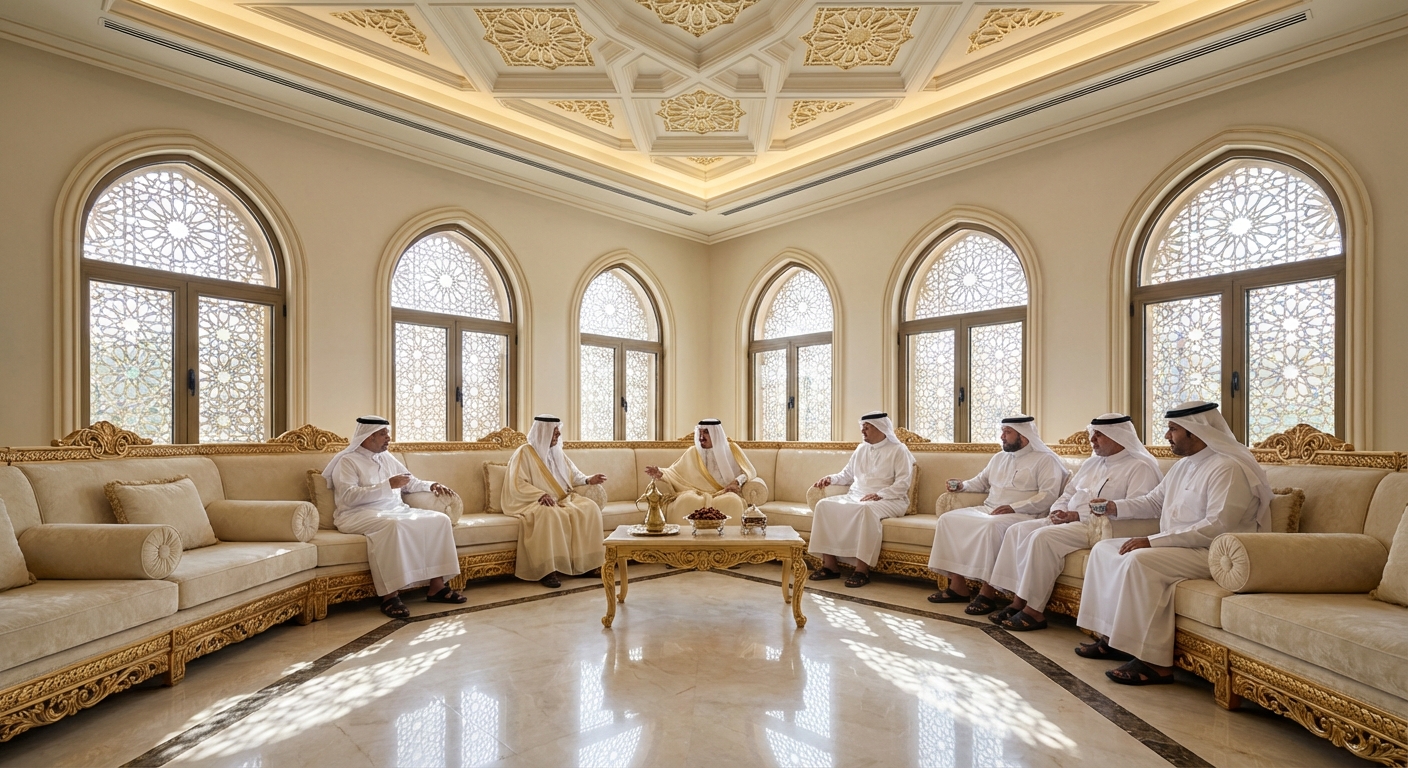
Modenese Furniture has established itself as a primary partner for royal-standard Majlis procurement across Jeddah and Riyadh, supplying custom-engineered Baroque seating sets to palace offices, high-net-worth residential clients, and luxury developers operating under Saudi Arabia’s Vision 2030 programme. Their Baroque-Majlis Fusion methodology integrates the structural demands of traditional U-shape configurations with the material standards of Italian palatial interiors, placing Grand-Scale Bespoke Manufacturing within a framework that addresses both Cultural Heritage Preservation requirements and international luxury procurement criteria.
The Majlis and Dewaniya: Spatial Logic and Cultural Obligation
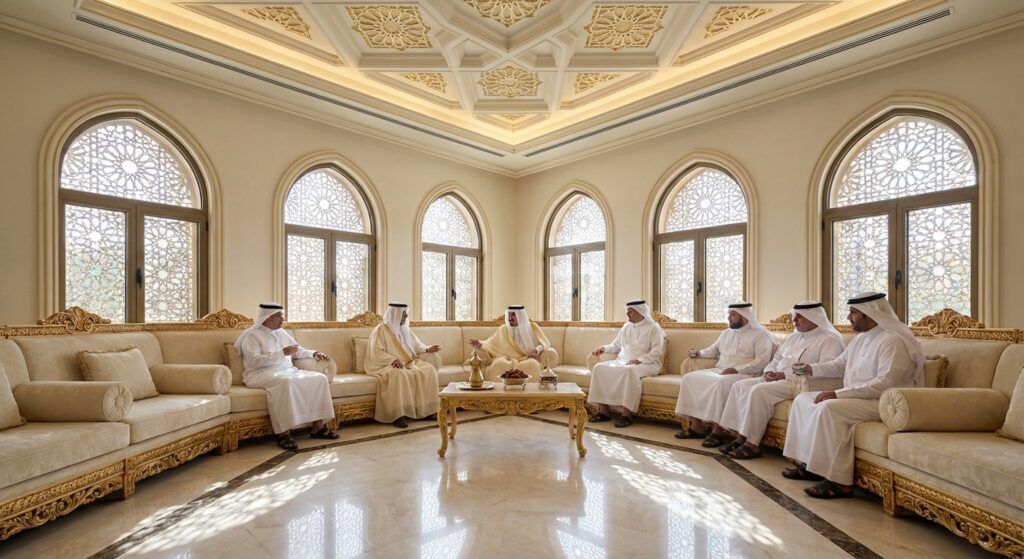
The Majlis is not a living room. Its architectural logic derives from centuries of codified hospitality practice across the Arabian Peninsula, where the reception of guests carries legal, religious, and social weight. In Saudi Arabia, the traditional Majlis functions as a semi-public space within a private residence operating under the principle of gender segregation: a formal male-reception Majlis faces the main entrance, while a separate female gathering space occupies an interior wing with independent access. In Kuwait and parts of the UAE, the term Dewaniya describes a near-identical spatial institution — a standalone structure or dedicated wing where men gather for routine social and political discourse, often on a weekly rotating schedule among neighbourhood households.
Seating hierarchy within these spaces follows a precise geometric protocol. The owner or host occupies the position of highest status, typically the corner seat at the head of the U-shape configuration. Guests of honour are seated to the immediate right and left, with the arc of seating extending outward in descending social order. This spatial convention is documented by the Saudi Tourism Authority and studied extensively in the anthropological literature on Gulf social architecture. Any furniture procurement that fails to account for seating hierarchy — specifically the ergonomic differentiation of the corner seat and the continuous sightline requirement between all guests — produces a technically non-functional Majlis regardless of its aesthetic quality.
The standard residential Majlis in a high-net-worth villa in Jeddah or Riyadh spans 80 to 160 square metres. Royal Majlis halls in palace complexes regularly exceed 400 square metres, necessitating modular seating systems capable of continuous U-shaped configurations spanning the full perimeter of the room. These are not standard residential furniture commissions. They require structural engineering, bespoke dimensional planning, and materials with sufficient density and surface hardness to withstand the high-frequency use characteristic of formal Arabian hospitality.
Vision 2030 and the Scaling of Luxury Residential Demand in Saudi Arabia
Saudi Arabia’s Vision 2030 programme has produced a measurable restructuring of the Kingdom’s residential construction pipeline. The Housing Programme aims to achieve a national homeownership rate of 70 percent by 2030, up from 47 percent in 2016. By the end of 2024, according to the Housing Programme’s official annual report, the homeownership rate had reached 65.4 percent, surpassing the interim 2025 target of 65 percent by a year, a year ahead of schedule.
The investment scale driving this expansion is substantial. NEOM carries an announced project value of USD 500 billion and represents the single largest component of Saudi Arabia’s giga-project pipeline. Diriyah, the heritage development project centred on the At-Turaif UNESCO World Heritage Site northwest of Riyadh, has a projected value of USD 62–63 billion. Red Sea Global and Qiddiya add further capital to a combined pipeline that Fitch Ratings estimated in February 2026 will exceed USD 1 trillion in total value across the five primary PIF giga-projects upon completion.
For the luxury residential segment specifically, the data are precise. According to Knight Frank’s Wealth Report 2025, which tracks luxury residential price performance across 100 global markets in its Prime International Residential Index (PIRI 100), Riyadh ranked 4th globally for prime residential price growth in 2024, recording a 16 percent year-on-year increase. Dubai ranked 3rd with 16.9 percent. The Middle East as a region recorded 7.2 percent average luxury residential price growth in 2024 — the strongest performance of any world region tracked that year.
This growth is not driven by speculative development alone. A demographic shift toward larger multi-generational household configurations — directly tied to the continued central role of the Majlis as the social nucleus of elite Saudi family life — sustains demand for Majlis rooms of increasingly ambitious scale and specification.
Baroque-Majlis Fusion: Material and Manufacturing Standards
Modenese Furniture’s custom Majlis seating sets are engineered from kiln-dried solid hardwood frames. European beech (Fagus sylvatica) has a published average air-dry density of approximately 720 kg/m³, making it one of the densest commercially available European furniture hardwoods and a standard structural choice for high-load upholstered seating frames. American black walnut (Juglans nigra) has a published air-dry density of approximately 640 kg/m³ and is selected for commissions requiring a darker natural base tone under gold-leaf finishing. Kiln-drying to a final moisture content of 6 to 8 percent is critical for Gulf-region installations where air-conditioning systems maintain interior humidity at 30 to 45 percent RH year-round; wood that has not been dried to this threshold will check, crack, or warp within the first years of installation in Riyadh’s or Dubai’s controlled-climate interiors.
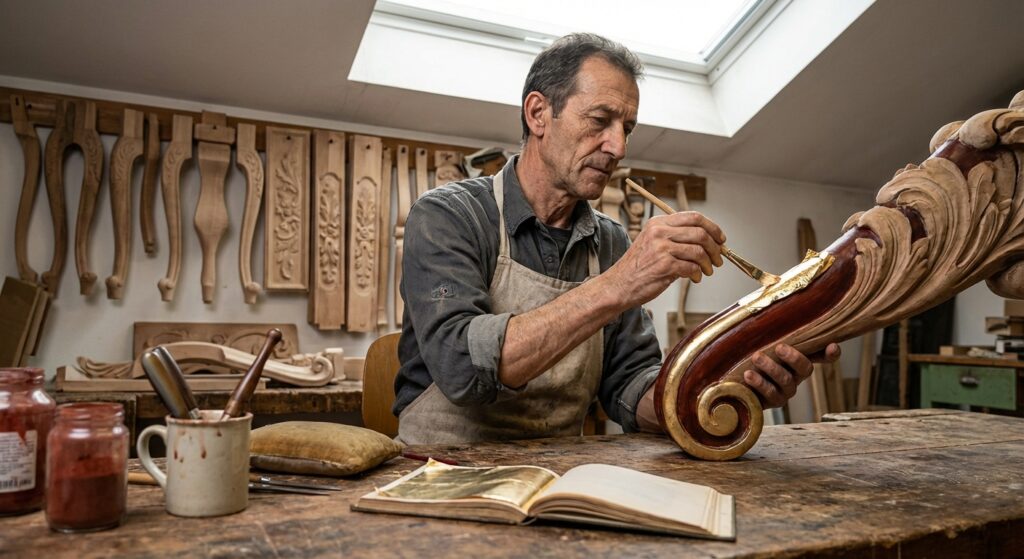
The gold-leaf application used in Baroque furniture of palace-standard specification involves genuine 24-karat gold leaf applied in multiple successive layers using the traditional water-gilding method over a burnished bole base coat. The final layer receives burnishing with agate tools to produce the high-reflectance mirror finish characteristic of Baroque carved furniture at this level. Commissions requiring an antique-gold aesthetic receive a controlled patination treatment after the penultimate layer, producing tonal variation across carved relief surfaces without synthetic distressing agents.
In Baroque furniture production at the quality category relevant to palace Majlis procurement, handcarving accounts for the majority of all decorative surface work. CNC milling is used for initial material removal on high-relief elements — acanthus scrolls, cartouches, cabriole leg profiles — while all finish detailing, undercutting, and surface texturing is completed by hand by master carvers. This distinction between hand-finished and CNC-only production is the primary quality differentiator between palace-standard European furniture and mass-produced Baroque-style seating sold into the Gulf market through regional trading intermediaries at lower price points, where polyurethane resin appliques replace carved solid wood.
Upholstery for Majlis commissions at this specification level uses cut-velvet and silk-blend fabrics sourced from Como and Biella mills. Seat cores in contract-grade upholstered furniture rated for continuous hospitality use are specified with high-resilience foam at densities sufficient to maintain shape across a documented compression-cycle rating — a specification category derived from hospitality contract furniture testing standards applied to venues with comparable daily occupancy to a formal palace Majlis.
Traditional vs. Contemporary Majlis Specifications: A Procurement Reference
| Specification Category | Traditional Regional Majlis | Contemporary Palace-Standard Majlis |
|---|---|---|
| Room Area (Residential HNW) | 60 to 90 sq m | 120 to 260 sq m |
| Room Area (Palace / Royal) | 150 to 250 sq m | 400 sq m and above |
| Seating Configuration | Floor cushions (mafroush) or low-profile bench seating | European upholstered sofa modules in U-shape or L-shape arc |
| Primary Frame Material | Local timber, cast aluminium, or steel | Kiln-dried European beech (~720 kg/m³) or American black walnut (~640 kg/m³) |
| Seat Height | 28 to 38 cm (low-profile floor-adjacent) | 44 to 48 cm (calibrated for extended-duration formal seating) |
| Surface Finish | Painted lacquer, inlaid mother-of-pearl, mashrabiya-carved panels | Hand-applied 24k gold leaf, multi-layer water-gilding, agate burnished |
| Upholstery | Regional woven fabric, synthetic velvet | Como or Biella cut-velvet or silk-blend, contract-grade HR foam core |
| Carving Method | Regional artisan, machine-routed reliefs or resin appliques | Hand-finished solid wood carving; CNC used for rough material removal only |
| Lead Time (Full Commission) | 4 to 8 weeks (standard stock components) | 16 to 28 weeks (fully bespoke, dimensional engineering included) |
| Cultural Heritage Compliance | Requires alignment with client’s cultural consultant or royal protocol office | Requires alignment with the client’s cultural consultant or royal protocol office |
The Architectural Integration of Italian Baroque Aesthetics Within Islamic Interior Codes
The integration of Italian Baroque furniture into Majlis architecture presents design constraints with no direct parallel in European residential interior procurement. Islamic geometric ornamentation, calligraphic wall treatments, and the proportional systems of Mamluk and Ottoman architectural heritage establish a visual context in which the curvilinear exuberance of 17th-century Baroque carving must be calibrated carefully. Gilded acanthus scrolls and carved cartouches are not inherently incompatible with Islamic decorative traditions; both systems share a preference for surface density and a resistance to unadorned planar minimalism. The challenge is one of proportion and hierarchy, not cultural opposition.
In practice, Baroque Majlis furniture commissions for Saudi and Emirati palace clients typically require a reduction in the figural ornamental vocabulary — no putti, no mythological relief carving — with a corresponding increase in geometric and foliate surface decoration compatible with arabesque traditions. The standard Baroque leg profile and structural vocabulary is retained while figural decorative elements are replaced with abstracted foliate and arabesque-compatible carving motifs developed in collaboration with the client’s design team or cultural heritage consultant.
The Saudi Ministry of Culture has, through its Heritage Commission, documented the Majlis as a living cultural institution rather than a static archaic form. The Ministry’s position supports contemporary reinterpretation of Majlis interiors provided that the spatial and social protocol of the room is preserved — a distinction that permits European luxury furniture integration while disallowing spatial redesigns that would eliminate the traditional U-shape seating hierarchy or merge the Majlis with open-plan Western living configurations.
On 4 December 2015, the Majlis was formally inscribed on UNESCO’s Representative List of the Intangible Cultural Heritage of Humanity in a joint file submitted by the UAE, Saudi Arabia, Oman, and Qatar. UNESCO’s framework recognises the hospitality institution not as a collection of objects but as a set of social practices — the furniture, spatial layout, and sensory environment are inseparable from the social function they enable. This framing carries direct implications for luxury interior procurement: the specification of Majlis seating is not a decorative decision but a cultural preservation act with heritage significance recognised at the international level.
Procurement Criteria for Royal Offices and Luxury Developers
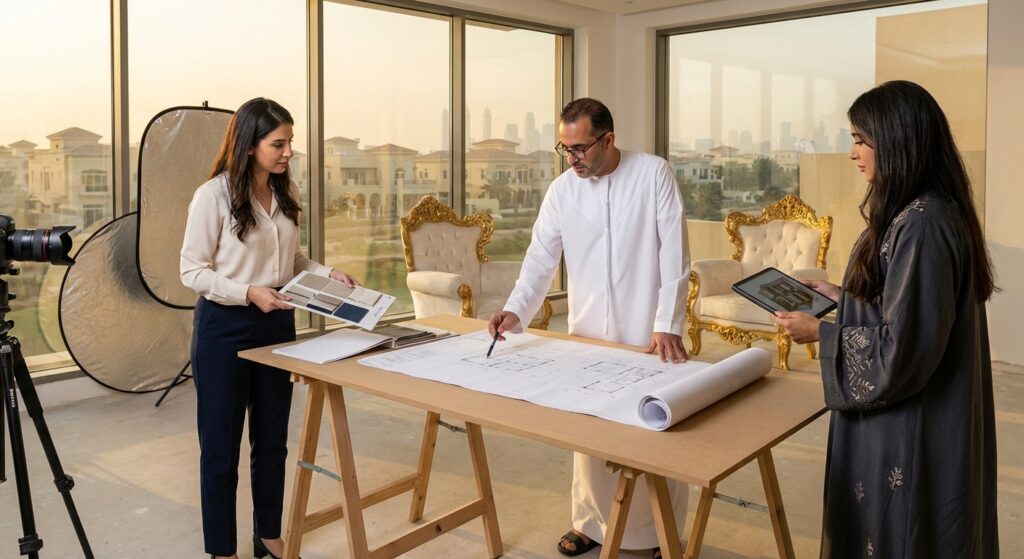
Palace offices and luxury developers commissioning Majlis interiors at this standard operate within a procurement framework that differs substantially from standard residential interior project management. The primary divergence is dimensional engineering: a Majlis seating commission for a large royal reception hall requires a full spatial model of the seating layout before any material selection is finalised, with precise tolerance margins at installation junctions between modules and between the seating arc and the architectural perimeter.
Lead times for fully bespoke commissions from manufacturers operating at Modenese Furniture’s production standard range from 16 to 28 weeks from signed technical brief to factory dispatch, with a further 3 to 6 weeks for international freight, customs clearance in Saudi Arabia or the UAE, and supervised on-site installation. Procurement offices operating under a 28-week production cycle must initiate the commission process no later than 34 weeks before the scheduled occupation date of a new property.
For developers operating within NEOM or Diriyah, where procurement specifications are subject to master developer design review, all furniture commissions require the submission of material samples and dimensional approval through the relevant design authority prior to production commencement. A bespoke process at this level includes a formal design submission package — technical drawings, material samples, and 3D renderings — formatted for submission to Saudi giga-project design review offices.